Building Resilience in Neurosurgical Residents: A Primer by Sotile PhD Wayne & Simonds MD Gary
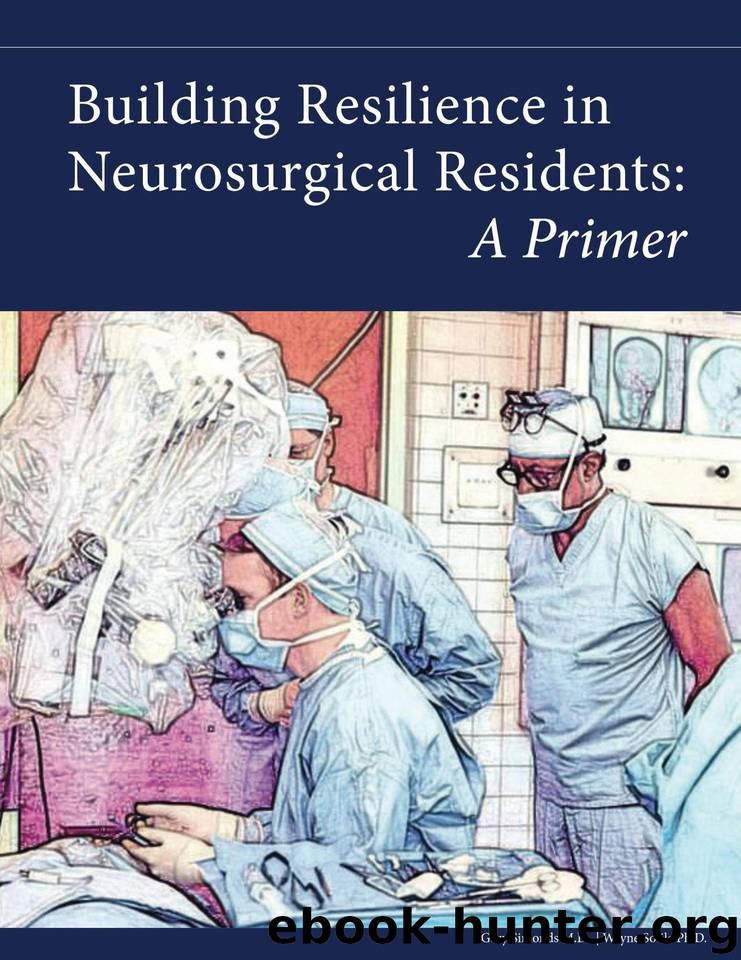
Author:Sotile PhD, Wayne & Simonds MD, Gary
Language: eng
Format: epub
Publisher: Unknown
Published: 2015-05-31T16:00:00+00:00
Beyond general discussions of the stresses of residency, it is important to recognize “teachable moments” for promoting deeper insights and abilities in self-regulation. Here, we are referring to those most painful of times; for example when witnessing the death of a child due to a parent’s negligence, or coping with a bad surgical outcome that could have been prevented. Helping residents to not only manage but also process their feelings of shock, despair, outrage, anger, disgust, guilt, and so on, is a life skill that can serve them well throughout their careers.
Building Resilience
-Don’t just focus on the events; spend time delving into the resident’s emotional responses, and how they are dealing with those emotions.
-Bring it up. If you know of a particularly disturbing event, call for discussion. Ask for perspectives on what happened and interpretations of why. Without blaming or analyzing, delve into the effects of the event on each of the residents involved.
-Normalize the residents’ reactions: “Sounds like you are sad and angry that a child died from abuse. You should be. So am I.” or “You were scared when the aneurysm burst, and that is normal. What is important is how you managed the fear.”
Remember: When a painful emotion is “given air” in a supportive environment it tends to dissipate; as opposed to concentrating in a cauldron of other negative emotions until it becomes combustible.
-Discuss strategies for dealing with painful emotions.
-Give residents permission to disrupt their ruminations. This may sound self-evident, but remember that witnessing horrific events may leave “survivors” feeling guilty (if/when they move on). Encourage residents to break their ruminations by engaging in healthy pleasures and distractions. Caution that, when stuck in a cycle of fueling emotional pain with ruminating thoughts, anyone is at high risk of reaching for unhealthy distractions (e.g., drugs, alcohol, compulsive behaviors).
-Explore individual negative emotions as their own entities; in each resident, what particularly elicits fear, frustration, anger, sadness, irritation, disgust, etc.
-Also, explore positive emotional responses- feelings of elation, accomplishment, joy, mirth, growth, fulfillment, excitement, worth, etc.
TO THINK ABOUT…. The Privilege of Being a Neurosurgeon
Another powerful foundation for professional resilience is the development and maintenance of a sense of meaning and purpose to one’s work. Remember; “Meaning is the antidote for burn-out and despair.” In the midst of a residency, with fatigue and streams of negative feedback pouring over the trainees, it is easy for them to become cynical and nihilistic, and to lose sight of the truly special position they occupy in society.
One of our attending neurosurgeons recalls fondly how when he was fretful and dejected about being on call one night as a junior resident, a senior resident came to his emotional aid. The senior mimicked a local bank commercial (“We are the most important bank, in the most important city, in the most important country, in the world”) telling him “Remember- you are the most important resident in the most important hospital in the most important city……” And, he was kind of right— at least about being an important cog in the wheel.
Download
This site does not store any files on its server. We only index and link to content provided by other sites. Please contact the content providers to delete copyright contents if any and email us, we'll remove relevant links or contents immediately.
| Administration & Medicine Economics | Allied Health Professions |
| Basic Sciences | Dentistry |
| History | Medical Informatics |
| Medicine | Nursing |
| Pharmacology | Psychology |
| Research | Veterinary Medicine |
Periodization Training for Sports by Tudor Bompa(8240)
Why We Sleep: Unlocking the Power of Sleep and Dreams by Matthew Walker(6688)
Paper Towns by Green John(5168)
The Immortal Life of Henrietta Lacks by Rebecca Skloot(4569)
The Sports Rules Book by Human Kinetics(4373)
Dynamic Alignment Through Imagery by Eric Franklin(4201)
ACSM's Complete Guide to Fitness & Health by ACSM(4043)
Kaplan MCAT Organic Chemistry Review: Created for MCAT 2015 (Kaplan Test Prep) by Kaplan(3994)
Livewired by David Eagleman(3757)
Introduction to Kinesiology by Shirl J. Hoffman(3755)
The Death of the Heart by Elizabeth Bowen(3599)
The River of Consciousness by Oliver Sacks(3590)
Alchemy and Alchemists by C. J. S. Thompson(3506)
Bad Pharma by Ben Goldacre(3414)
Descartes' Error by Antonio Damasio(3264)
The Emperor of All Maladies: A Biography of Cancer by Siddhartha Mukherjee(3135)
The Gene: An Intimate History by Siddhartha Mukherjee(3086)
The Fate of Rome: Climate, Disease, and the End of an Empire (The Princeton History of the Ancient World) by Kyle Harper(3049)
Kaplan MCAT Behavioral Sciences Review: Created for MCAT 2015 (Kaplan Test Prep) by Kaplan(2973)
